- Pet Damage
- hardwood-repair
- Hardwood Refinish
- Maryland
Pee-Damaged Wood Floors in Maryland: What Sands Out, What Doesn't, and What It Costs
Quick insights
- Pet urine is the only common floor stain we will not promise to sand out. The black mark is not dirt on the finish — it is a chemical reaction deep in the wood, and how deep it went decides everything about the price.
- Urine is roughly pH 6 when fresh and turns alkaline (pH 8–9) as it breaks down. That alkalinity attacks polyurethane, then reacts with oak's natural tannins and any iron in the fasteners below to leave the black halo you're looking at.
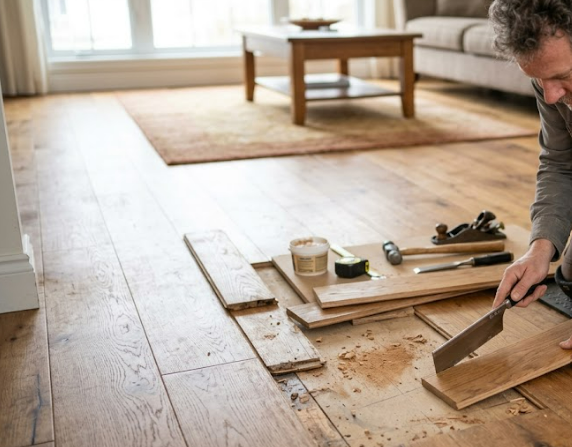
- A light sand takes off about 1/32" of wood, and a full 3⁄4" solid oak floor only has roughly ¼" of usable wear above the tongue. A deep urine stain routinely goes further than that — which is why the honest answer is often board replacement, not sanding.
- The smell lives in the subfloor, not the finish. Refinishing over a contaminated subfloor buys you about one Maryland summer; the first humid July brings the odor straight back through the new coat.
- Typical Maryland numbers: $3.50–$6 per sq ft to sand and refinish, $250–$900 for a localized board-replacement patch, and $2–$5 per sq ft more when the subfloor has to be cut out, sealed, or replaced.
- In older Montgomery County housing stock — the 1920s–1950s oak in Silver Spring, Takoma Park, and Chevy Chase — strip oak sits straight on a plank subfloor with no vapor barrier, so urine travels along the gaps and shows up feet away from where the dog actually went.
- If the dog isn't going anywhere, the right long-term answer in a mudroom, laundry, or lower level is usually waterproof rigid-core LVP at 20 mil wear layer or better — and site-finished oak kept where it belongs, upstairs.
What pet urine actually does to a wood floor
Homeowners call this a stain. Chemically it's closer to a slow burn, and understanding the three stages is what tells you whether you're facing a weekend or a project.
Stage one: the finish. Fresh urine sits around pH 6, but as bacteria break down the urea it turns alkaline — commonly pH 8 to 9. Alkaline liquid sitting on polyurethane softens and dulls it. That's the cloudy, slightly sticky patch you notice before any color shows. Caught here, on a floor with an intact finish, it genuinely is a wipe-up.
Stage two: the wood. Once the finish is compromised, the liquid goes into the grain. Oak is loaded with tannins; urine salts plus tannins plus iron from cut nails, floor staples, or an old register grate produce the dark grey-to-black halo everybody recognizes. This is the same chemistry that makes oak turn black around a wet nail head, accelerated. It is in the wood fiber, not on it.
Stage three: everything under the wood. Liquid that gets past the boards goes into the seams, the paper (if there is any), the subfloor, and sometimes the joist bay. That's where the odor lives permanently, because it never dries and never gets cleaned — and it's why a floor can smell fine in February and smell like a kennel the first humid week of July. Humidity re-activates urine salts. Every Maryland August proves it.
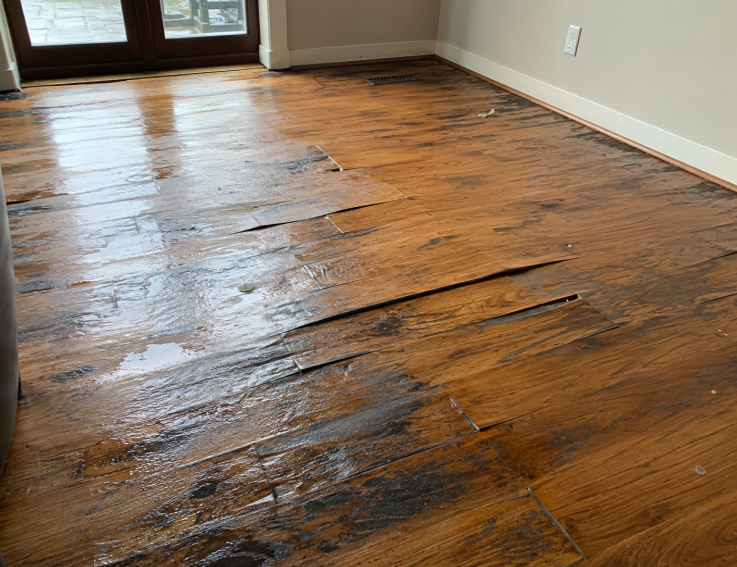
One more thing that surprises people: where you see it is not always where it happened. In the 1920s–1950s strip oak all over Silver Spring, Takoma Park, and Chevy Chase, ¾" boards were face-nailed or stapled over a diagonal plank subfloor with no vapor barrier at all. Liquid runs along those seams. We have pulled boards in Woodside Park where the visible black spot was four feet from the actual saturated zone under the floor.
How to tell what you're dealing with, before anyone quotes you
You can do most of this yourself in ten minutes, and it will tell you whether the next call is a cleaning question or a contractor.
The black-light test
Turn every light off after dark and run a cheap UV flashlight across the floor at a low angle. Dried urine fluoresces a dull yellow-green. Do the whole room, not just the spot you know about — in rentals and in houses where a dog has aged, the map is almost always larger than the owner expects. Mark each spot with painter's tape. That taped map, photographed, is the single most useful thing you can hand an estimator.
Read the color
- Light tan or amber, finish still glossy: surface-level. Clean it properly and it likely disappears.
- Grey or light brown, finish dull or gone: it's in the wood. Sanding usually gets it, but not always to a perfect match.
- Black, with a defined halo edge: deep tannin reaction. Assume sanding will not remove it. Plan on replacing those boards or accepting the mark.
- Black plus cupping, crowning, or boards that move underfoot: the subfloor is wet or rotted. This is now a structural repair, not a refinish.
The smell test that actually means something
Close the room up, turn the heat or the humidity up for a few hours, and come back in from outside. Warm, humid air drives urine odor out of the substrate. If it smells strongly then, the contamination is below the finish — and no amount of sanding and coating is going to solve it.
Check your remaining wood
Pull a floor register or the threshold at a doorway and look at the edge of a board. A solid ¾" floor has roughly ¼" of usable wood above the tongue, and each full sand takes about 1/32". A floor already sanded three times in a 1940s Takoma Park bungalow may have one pass left — and spending it chasing a black stain that won't come out anyway is the wrong way to use it. Engineered floors are stricter still: a 2mm wear layer gets one light sand, and a 0.6mm veneer gets none.
What sands out, and what doesn't
Here is the part most contractors are vague about, so we'll be blunt.
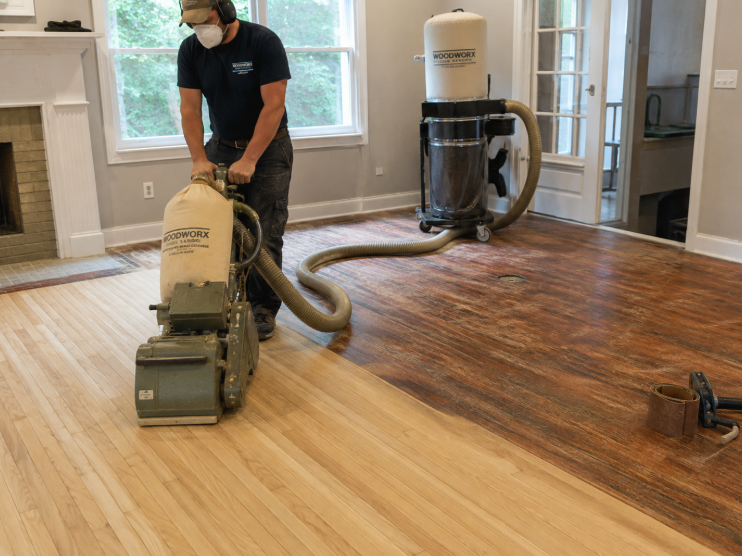
Sanding removes surface and near-surface staining. It does not remove deep urine blackening, and it does not remove odor. The drum takes off a few thousandths at a time; a urine stain that has been soaking into end grain for two years is often through the full wear layer and into the tongue. We have sanded floors in Rockville and Olney down to the last safe pass and had the halo still sitting there, lighter but present.
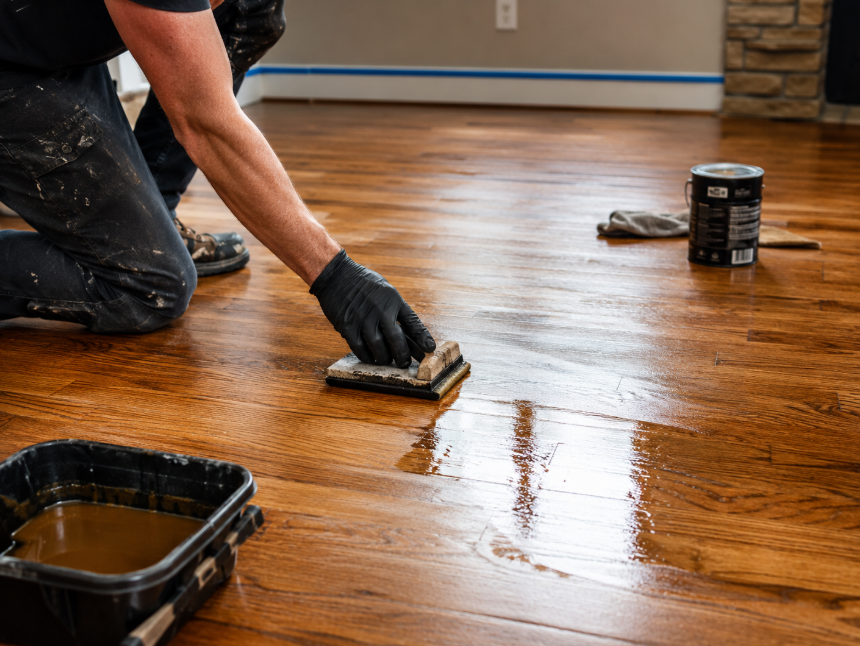
The middle option is oxalic acid bleaching — wood bleach, applied to bare sanded wood, neutralized and rinsed. It genuinely lightens tannin-reaction blackening and it's a legitimate professional step. What it is not: a cure. Oxalic lightens a spot rather than erasing it, it can leave that area slightly blonder than the surrounding floor (which stain then takes differently), and it does nothing whatsoever for odor. On a wide-plank floor in Potomac where one board is marked, bleaching and blending is often the smart call. On a hallway with eleven spots, replacing boards produces a floor you'll actually be happy with.
Board replacement is the reliable fix. We cut out the affected boards, inspect and treat what's under them, weave new material into the existing field so the seams are staggered rather than blocked, then sand the room as one floor so the patch disappears. In older Maryland homes the wrinkle is matching: 2¼" red oak strip is still easy to source, but 1½" strip, quarter-sawn white oak, or a 1930s pattern border takes salvaged material and a patient carpenter. That's normal work for us in Silver Spring and Chevy Chase, and it's the difference between a repair you can see from the doorway and one you can't.
And sometimes the right answer is keep the mark. On a 1928 floor with character everywhere, in a house where the dog is still living, spending $1,400 chasing one halo under a table is a choice, not a necessity. We'll say so.
When the subfloor has to come up
This is the step homeowners most want to skip and most regret skipping.
If the odor test came back strong, if the boards are cupped or spongy, or if the staining shows on the underside of the boards we pull, the liquid is in the substrate. Refinishing over that is spending real money on a floor that will smell again by the first humid stretch. The sequence that works:
- Pull the affected boards and look. Not a guess from above — the underside of the board and the face of the subfloor tell you immediately.
- Meter it. Wet subfloor gets dried to a stable reading before anything goes back down. Trapping moisture under a new floor produces cupping later, and the two problems stack.
- Clean with an enzymatic product, not a household cleaner. Enzymes break down the urea salts; bleach and vinegar mask, and household ammonia products actually smell like a fresh target to a dog.
- Seal it. A shellac-based primer-sealer (the classic pigmented shellac in a can) over the cleaned, dry subfloor is the standard odor-blocking step. This is the single most skipped operation in pet-damage repair and the reason so many "already fixed" floors smell again.
- Cut out what's saturated. Plywood or plank that's soft, delaminated, or black all the way through does not get sealed, it gets replaced. On a badly saturated spot the joist top sometimes needs treatment too.
The Maryland twist is grade level. In the split-levels and walk-outs common in Germantown, Clarksburg, and Upper Marlboro, the room where the dog is crated is usually the lower level — on or below grade, where slab moisture already keeps things damp and where odor has no way to dry out. A floor like that with a urine history is the clearest case there is for replacing wood with waterproof material rather than restoring it. If there's also been standing water down there at any point, start with our water-damaged floor process, because you have two problems in the same assembly and the moisture one comes first.
What pet urine floor repair costs in Maryland
These are our own published Maryland rates, scaled by town, not a national calculator average. Pet damage almost always ends up as a combination of two or three lines rather than one.
Two real jobs, rounded, to make it concrete. A 1952 cape in Silver Spring: one aging dog, six taped spots down a 180 sq ft hallway, black on three. Nine boards replaced, subfloor cleaned and shellac-sealed under two of them, whole level sanded and finished — the repair was a few hundred dollars and the refinish carried the rest. A walk-out lower level in Germantown with a crate corner and years of accidents: the wood came out, the slab-side subfloor was sealed, and the room went down in 20-mil rigid-core LVP for roughly what a full hardwood restoration would have cost — except this one will survive the next dog.
One note on insurance, because people ask: homeowner policies in Maryland generally treat pet damage as gradual wear rather than a covered sudden loss, so plan on paying for this out of pocket. A burst supply line is a claim; a dog is a maintenance item. Where it does show up financially is at sale — buyers' agents and inspectors flag pet odor immediately, and it drags a whole house's perceived condition down with it.
Stopping it happening again
Restoring a floor and changing nothing else means doing this twice. What actually works, in order:
- Clean accidents the same day, with enzymes. Blot, don't rub. Enzymatic cleaner, dwell time per the label, then dry. Never ammonia-based cleaners — they read as urine to a dog and mark the spot for reuse.
- Never steam-clean or wet-mop wood. Steam drives moisture and whatever is in it straight through the seams. It's the fastest way to turn a stain problem into a cupping problem.
- Keep nails trimmed and use a quality finish. A modern commercial-grade waterborne polyurethane is meaningfully more resistant to alkaline liquids than the 1980s oil-based coating on most older Maryland floors, and it's what we spec on any refinish in a house with animals.
- Rethink the room, not just the floor. Crate corners, mudrooms, laundries, and lower levels are where 90% of this damage happens. Waterproof rigid-core LVP at 20 mil or better in those rooms, with hardwood kept to the main level and stairs, is the combination we install for pet owners across the county almost every week.
- Hold your indoor humidity at 30–50%. This one is quietly the most important, and the one nobody connects to pets: damp air keeps residual urine salts active and the odor alive, while dry winter air opens the board gaps that let the next accident get underneath. Stable humidity protects both the wood and your nose.
That last point deserves a bit more than a bullet. Maryland runs humid from May through September and then drops under 25% relative humidity indoors once the furnace comes on, and a floor that lived through pet accidents feels both extremes harder than a clean one. Holding a steady 35–40% all winter is a mechanical job, not a flooring one — it means a properly sized whole-house humidifier on the furnace, a serviced water panel, a clear drain line, and register deflectors where hot air blows straight across wood. If your system can't hold a setpoint, that's worth a conversation with a qualified HVAC contractor before you spend anything on sanding, because the humidity swing will keep working against the repair we just made. We've watched a $40 hygrometer and a correctly set humidifier save floors that were otherwise on a two-year path to replacement. More on the seasonal side of this in our guide to hardwood floors in a Maryland winter.
When to call us, and what we'll actually do
Call when you see black staining with a defined edge, when the odor returns in humid weather, when boards cup or sound hollow, when you're preparing to list the house, or when a rental turnover has left you with a floor and a deadline.
What happens on the visit: we black-light the room so we're working from the real map rather than the visible spots, meter the boards and the subfloor, pull a register or threshold to gauge how much sandable wood is left, and where it matters, lift one board to see what's underneath before anyone quotes a refinish. Then you get a written, itemized number — sanding, replacement, subfloor work and sealing broken out separately — honored for 60 days. If the honest answer is "this stain isn't coming out and the floor isn't worth what it would take," we'll say that too.
Call (240) 343-3514 for a free in-home estimate. Start with the service you need — repair & restoration, refinishing & sanding, water damage repair, luxury vinyl plank & tile, installation, or stairs — or go straight to your town: Bethesda, Rockville, Silver Spring, Chevy Chase, Potomac, North Bethesda, Olney, Germantown, Clarksburg, Takoma Park, Cabin John, Annapolis, Frederick, Fulton, Clarksville, or Upper Marlboro.
Sources
- National Wood Flooring Association — sandable wear-layer limits for solid and engineered flooring, and the 30–50% relative humidity / 60–80°F service environment wood flooring is designed for.
- National Association of REALTORS®, Remodeling Impact Report — cost recovery for hardwood floor refinishing (~147%) and new wood flooring (~118%).
Pricing reflects our own Maryland rates across Montgomery, Howard, Anne Arundel, Frederick, and Prince George's counties; stain-depth and odor observations are from our own field work.